
Urban Lab Camp 2024| Degrowth: Reflections from the Global
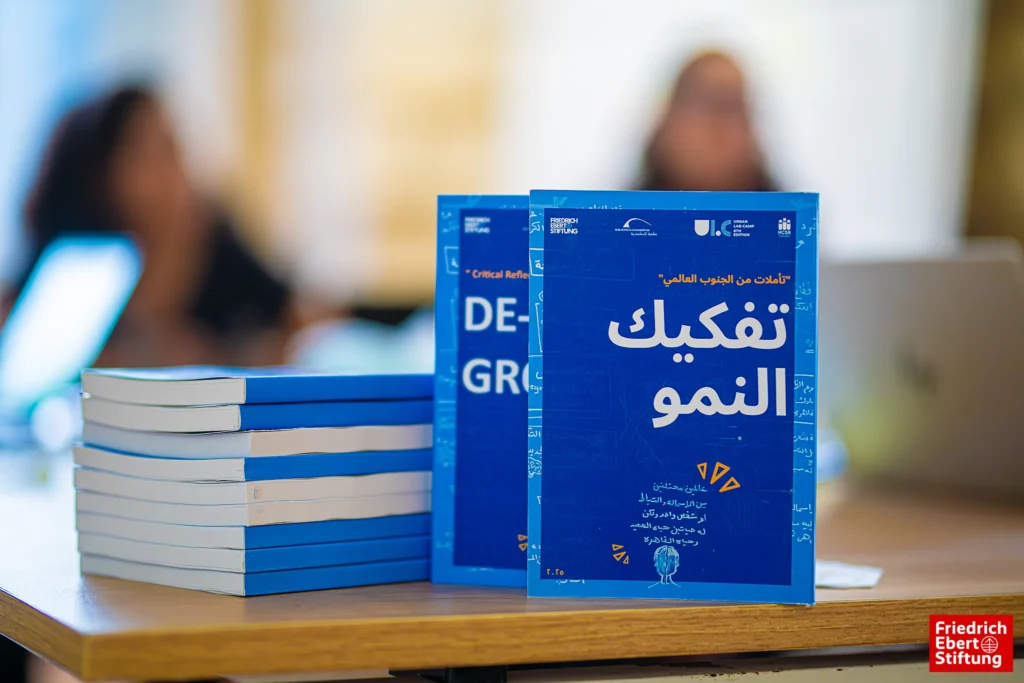
“It seems that the world is growing in reverse for us, the countries of the South.” An ascending straight line is often expected in economic growth, as such development projects and narratives are founded and created. Nations compete over natural resources to continue this upward trajectory towards prosperity. However, the flip side of this expectation to maintain the speed and boldness of the ascending straight line is that it moves like a carriage, breaking bodies in its path. Is it possible to slow down so that to think or reconsider the trajectory? Are nations really growing, or is it just a silly game that the world has been engaged in for thousands of years and has not lost its allure? This publication features the outcomes of the sixth Urban Lab Camp (ULC) held in Port Said from 12 to 16 September 2024, in partnership between Friedrich-Ebert-Stiftung (FES) Egypt Office, and the Bibliotheca Alexandrina, in collaboration with the Human and the City for Social Research (HCSR) and several specialists showcasing the Urban Lab Camp methodology as a cooperative platform of critical knowledge production on the intersections of urbanism, climate change and development. The volume focuses on the concept of “degrowth” from the perspective of the Global South, and specifically from the Egyptian experience, as an entry point to questioning the globally-dominant growth patterns and their relationship with urban transformations, climate changes and climate and social justice. Texts tackle the intersections of urbanism, consumerism, and managing natural resources, and pose questions on the beneficiaries and the marginalized from growth, and the possibilities of alternative paths towards a more just and sustainable development. Participants exceeded twenty, with varied educational and professional backgrounds across economics, urban planning, agriculture, arts, and humanities, and geographically ranging from the far north on the Mediterranean coast to the far south in Aswan, reflecting different approaches to the Egyptian experience and its positionality within the Global South. Such a publication aspires to be a tool for critical thinking, opening spaces to reconsider the concepts of progress and development, and relate them to the cities’ need and local potentials.
Themselves the Verge of Seas to be:Scientists and Storytellers of the Rising Sea in Alexandria

Soha Mohsen[1] Introduction According to the United Nations’ best-case scenario, at least 30% of the city of Alexandria will be flooded and over a quarter of the population will have to be rehoused by the year 2050. As reported by the UN Climate Panel (IPCC) in their 6th assessment report, the rising sea level of the Mediterranean due to climate change will have dramatic implications because its deep waters will warm more than all the oceans. This suspended futurity of Egypt’s second biggest metropole and its most historically significant port city intimately intersects with the overall uncertainty and instability lived and experienced by Egyptian subjects in the complicated and prolonged aftermath of the 25 January 2011 revolution, whereby the discourse of “sinking” operates not only on the level of city’s materiality but also on the level of a collapsing national economy. The shore that is disappearing and being lost to the Alexandrian public- due to the rapid and aggressive privatization by the state- is the same shore that is witness to the rising sea levels due to global warming. Taking this paradox between the appearance/ disappearance of the sea-and-land scopes, this project seeks to understand how the rising sea becomes the site of contested epistemologies, imaginations and representations in Alexandria, in relation to Egyptian politics, cultural production and scientific discourse. Drawing on ethnographic fieldwork and archival research, this paper begins by introducing the context of my study, elaborating on Alexandria’s status of “endangerment” as demonstrated and discussed by local and national oceanographic and marine scientists. After that it moves on to share a brief reflection based on ethnographic interviews and archival research, exploring the history of the oceanographic sciences in Egypt (specifically along Egyptian Mediterranean), namely the establishment of the National Institute for Oceanography and Fisheries (NIOF) as well as the Department of Oceanography at the Faculty of Sciences in Alexandria University. I aim to understand the complex subjectivity that oceanographers and marine scientists embody in endangered coastal cities, and the ways in which their personal and professional encounters with the sea shape and become shaped by the larger political, economic and cultural atmospheres of Alexandria. Lastly, the paper ends with a discussion of the nature of knowledge making about the sea-level rise (or the absence thereof) that unfold in relation to, about, and in proximity to the sea. Note on methods used: The vignettes presented in this paper are based on fieldwork over 9 months from September 2023 to May 2024. During this period of ethnographic fieldwork, I deployed several ethnographic methods simultaneously, such as: archival research, semi-structured interviews, and participant observation. The data/ findings in this paper are based on in-depth, semi-structured interviews with members from the National Institute of Oceanography and Fisheries and the Department of Oceanography at the Faculty of Sciences, Alexandria University, combined with my experience as a Visiting Researcher at the Human and the City Center for Social Research (HCSR) in Alexandria during the period between November 2023 and May 2024. I am tremendously grateful to HCSR team for welcoming me into their space and for continuing to provide me with profound insights about the urban, sociocultural and maritime histories of Alexandria. Context: The IPCC AR6 report advises that climate change will exacerbate storm surges and coastal flooding in the eastern Mediterranean basin in the upcoming decades. The above is particularly critical for low-lying arid cities in developing nations like Alexandria. Alexandria projects a high-end rate of sea-level rise ranging between 6.4 and 7.8 mm per year (IPCC 2021). The sea level is expected to rise between 0.2 m and 0.25 m at Alexandria by 2050, threatening fisheries on the Mediterranean Sea coast in Egypt and its low-lying coastal tourist areas (World Bank Group, 2014, p. 129). As the report indicates; “Egypt, Libya, Morocco and Tunisia are the most exposed countries to sea-level rise (World Bank, 2014). Among MENA countries, Egypt is particularly exposed with several coastal cities at risk of inundation (Frihy et al. 2010; Solyman and Abdel Monem, 2020; Elshinnawy and Almaliki 2021).” I started my fieldwork journey in Alexandria in the windy fall season of 2023, with certain expectations about the anxious atmosphere of a city that is on the brink of “sinking”. “Being there” (Favret-Saada 1990; Giordano 2023) among different local communities of residents, scientists, researchers and cultural producers, introduced me to a different, even more nuanced reality. Living in Alexandria, working among and with local communities, I came to contact with a scene of loss that, surprisingly, is not on-the-way but already here, acutely present and powerful. Whether Alexandria is going to sink, partially or completely, or not at all, is an issue discussed and ‘assessed’ by numerous scholars and scientists, and investigated in multiple past and ongoing research projects. Consulting these reports, documents, announcements and studies while also living in the city, I came to realize that the notion of sinking quite poetically and with precision captures much of the present condition in Alexandria. Echoing Stefan Helmreich’s remarks on seawater as a theory machine, I suggest that seawater has become an explicit figure for anthropological and social theorizing, “especially in the age of globalization, which is so often described in terms of currents, flows, and circulation”. I also join Helmreich in his critical take on the generativity of watery metaphors to our modes of social and cultural analysis. Similar to him, I am interested in employing sea-water as a theoretical and an explanatory tool (theory machine) while at the same time as a phenomenon to be examined in and of itself (a thing in the world) (Helmreich 2011). “An estimated 45 percent of the population of Alexandria currently lives on land situated below sea level” (Michel 2010). In Alexandria, for a scenario involving a sea level rise of 0.5 meters over the next century, about 30% of the city would be lost to inundation and saltwater intrusion if no countermeasures were taken (ElRaey 2010). How is sea level rise encountered, known, and conceptualized in Alexandria? How does
Workers between Climate Change and Decent Work [Webinar]
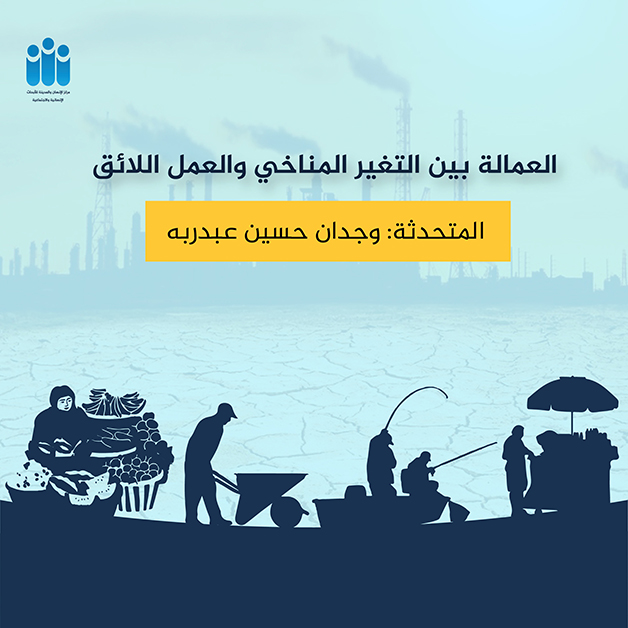
Climate change and decent work are among the challenges of the twenty-first century that have long been dealt with in isolation despite their close association. Moreover, the growing impact of climate change in the absence of decent work standards is causing great harm to workers and employment policies. The lecture attempts to shed light on the definition of decent work and its relationship to climate change; the opportunities offered by green economy and how to achieve social and climate justice for all from a labor perspective; some success stories in achieving environmental sustainability from all over the world; and the role of international union federations and the ILO in dealing with the risks of climate change on the future of employment. Speaker: Wejdan Hussein Abd Rabbo; a syndicalist interested in environment and gender. Kindly visit our channel; to watch the Webinar and more!
Is the City Sinking? Alexandria Facing Climate Change
In the occasion of hosting the Conference of Parties in the United Nations Framework Convention on Climate Change (COP27) in Sharm el-Sheikh from 6 to 18 November 2022 with the participation of more than 40,000 people from all over the world, the UN Secretary-General, Anthony Guterres, gave a speech in which he emphasized that climate change is happening at catastrophic speed, and noted that sea levels are rising at twice the speed of the 1990s— posing an existential threat and threatening billions of people in coastal areas. The danger of sea level rise on the northern coasts of Egypt, especially the Nile Delta and Alexandria, has become a source of great concern to the Egyptian population and relevant parties, coinciding with the warnings based on international and local studies, which alerted to the danger of sea level rise change. In this research paper, we review the location of the city of Alexandria on the Egyptian coast, the natural characteristics of the city and the history of the flooding and sinking of some of its parts in the past, to clarify the general context and the conditions that result in the extent of vulnerability to climate change. The second part explores the causes of sea level rise, climate change scenarios, the occurring and expected changes to sea level according to these concepts. It then moves to the threats of future floods and the impact of climate changes on rainfall and temperature in the city. To read the research in Arabic: Click here! Source of the cover photo: Yasmine Hussein
Must Know about COP

In November, Egypt hosts the twenty-seventh Conference of Parties (COP 27) in Sharm El-Sheikh. In light of this and our coverage of this international mega event, believing in the importance of community awareness, we start with the most important definitions: What is COP? The Conference of Parties is the decision-making body responsible for monitoring and reviewing the implementation of the United Nations Framework Convention on Climate Change (UNFCCC). Who are the parties? They are the 197 countries and territories that have signed the framework agreement, including Egypt. When is the conference held and what are its most important achievements? COP has been held annually since its first edition in 1995. Perhaps its most important achievement is the unification of countries in the first international climate agreement to reduce the risks of climate change. Kyoto Protocol: About Kyoto Protocol Date: 1997 Number of signatories: 195 countries Goals: to reduce the emission of 6 specific gases: carbon dioxide, methane, nitrogen oxide, in addition to three fluorescent compounds, by 5.2%, compared to 1990. Role: It places the responsibility for implementing the brunt of the commitments on the shoulders of the developed countries, as the protocol obligates them to provide all forms of financial and technical support to help developing countries implement the obligations arising from common international policies to protect the environment from pollution. Paris Agreement The Paris Climate Agreement is an output of the COP 21 held in the French Capital in 2015. Based on the Kyoto Protocol, it was effectuated in November 2016. About The Paris Agreement: Date: December 2015 Number of signatories: 194 Objectives: – Addressing the problem of greenhouse gas emissions and finding ways to adapt to it – Paying serious attention to the effects of climate change – Limiting temperature rise to less than two degrees Celsius Most important terms: – Reducing the intensity of greenhouse gas emissions by reducing energy consumption, investing in clean energies and reforestation. – Strengthening efforts to limit the temperature increase to 1.5 degrees Celsius Role: The agreement commits rich countries to provide 100 billion USD annually starting in 2020 to developing countries for helping them finance renewable energies. What is IPPC? Conventional energy vs Renewable energy In light of the global energy crisis, rising prices and the planet’s suffering from climate change, attention is turning towards renewable energy. Is clean energy the world’s only hope for a better future?To answer this question, we will review the most important benefits of each of the two energies and their limitations.
Impact of War on Climate Change
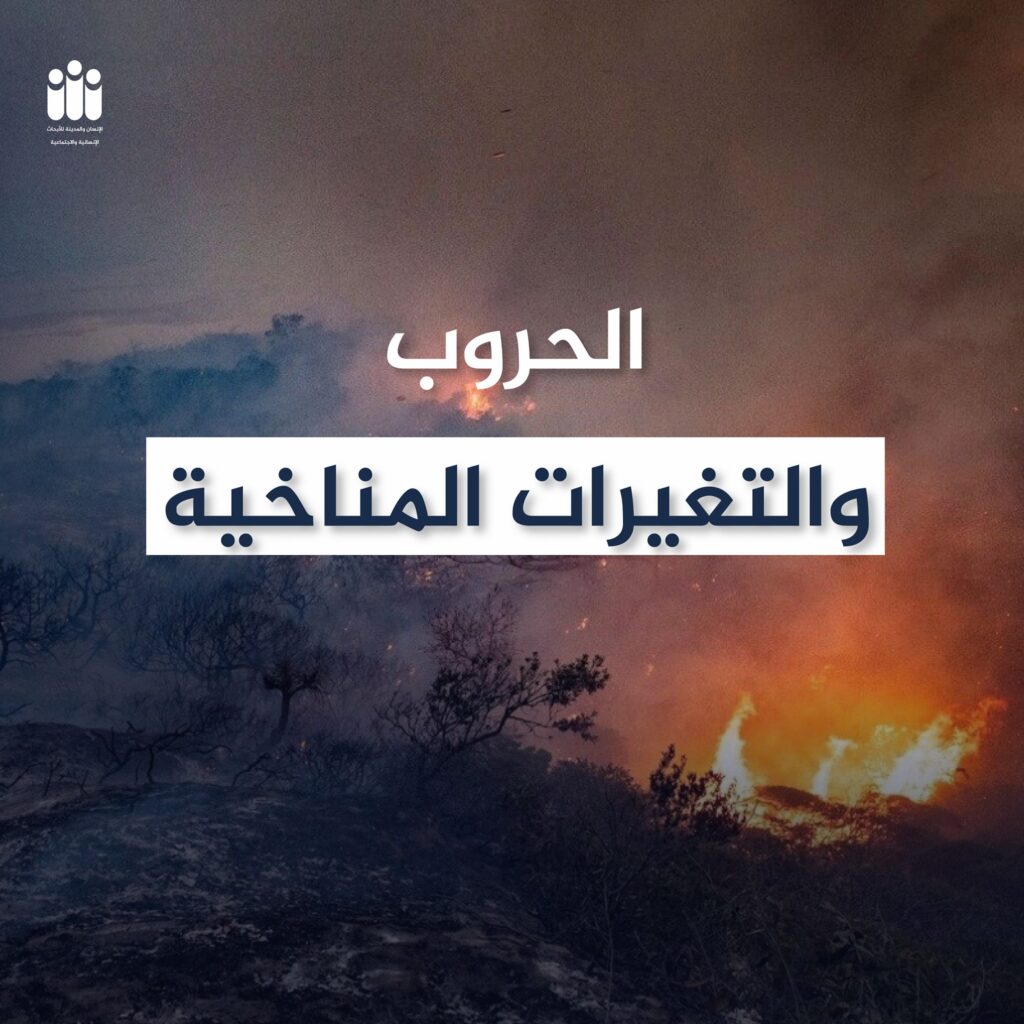
Since the dawn of history, war have been part of the human experience. When we think of war, scenes of bloodshed, hideous corpses, demolition of homes, dismantling families and leaving homelands come to mind. The environment is one of the unknown and silent victims of wars. Habitat destruction may ruin the ecological system at large, encompassing air pollution, land degradation, biodiversity loss, harm to marine life. These impacts may extend to tens of years affecting human lives as well as contributing to climate change. At a time when scientists, thinkers and various concerned authorities dealing with climate changes struggle to maintain normal temperature rates and work to stop its rise, we see new wars added to the list, such as the conflict between Russia and Ukraine, whose consequences are expected to be catastrophic on climate changes due to the energy crisis it generates. The United States, Saudi Arabia and Russia are among the top three countries in the fuel trade, and Russia is the first source of natural gas to Europe. Due to the ongoing conflict between Russia and the West, European energy security is under threat from Putin. The Russian president refused to accept the cost of natural gas either in US dollars or in Euros, and insisted on receiving in his country’s currency, the Russian ruble. The United States and Europe have begun stockpiling their coal as a precaution in case Russia refuses to sell them natural gas or decides to stop providing financial support to ease the pressure of the war on Ukraine. Germany and some neighboring countries have already temporarily returned to relying on coal until the crisis is resolved or alternative sources of natural gas are found. The problem lies in not knowing the actual length of this temporary period, as it may extend to several years. It is also expected that this will not only be limited to Germany and some neighboring countries, but will include all of Europe, after they were on the path of the complete banning of the use of coal by 2038[1]. The situation was further complicated by the sabotage actions against the two gas pipelines: “Nord Stream 1” which started its work in 2011 and is able to transport 170 million cubic meters per day of gas, and “Nord Stream 2” which was supposed to transport 55 billion cubic meters of gas but was discontinued by Germany in response to the Russian war on Ukraine[2]. Given the damage to the two gas lines, it is expected that repairs will not be completed before six months at best, which confirms the fact that the upcoming European winter will be the most difficult with high gas prices and scarcity, and consequently high prices of electricity needed for heating, which brings us back to the use of wood as a heating source; thus, logging huge numbers of trees for this purpose. The problem of returning to coal use is not only in extraction, manufacturing, transportation or trade, but rather lies in the process of its combustion. It is the largest contributor to the increase in carbon dioxide in the atmosphere. Coal-fired electricity generation produces nearly twice as much greenhouse gases per kilowatt as compared to natural gas generation[3]. If this shift in energy sources occurs, it will jeopardize attempts to maintain global warming (by only 1.5°C) and existing efforts to try to reduce carbon dioxide concentrations (to 350ppm) at serious risk. During wars and armed attacks, green spaces are destroyed or burnt; this leads to a rise in carbon dioxide in the atmosphere, in addition to destroying the natural habitats of animals, birds and other living creatures that use forests and green spaces as their environment. As green spaces are destroyed, it becomes more and more difficult to get rid of carbon dioxide and it remains in the atmosphere for a longer time. Militaries consume huge amounts of fossil fuels, which directly contribute to global warming. For example, if the US army were a country, it would have ranked 48th in terms of total emissions around the world[4]. As most countries invest more money in their armies, the use of fossil fuels is rising, with or without conflict. And while the military (even without engaging in wars) contributes to climate change, active warfare increases this contribution exponentially. For example, the United States and allied forces have launched more than 337,000 bombs and missiles at other countries over the past 20 years[5]. Airplanes used to load and transport these weapons burn about 16 liters of gasoline per kilometer[6]. With the explosion of each bomb, the percentage of carbon dioxide in the atmosphere increases, in addition to destroying the soil and green spaces, which are among the most important sinks of carbon dioxide. The so-called US war on terrorism has produced 1.2 billion metric tons of greenhouse gases in the atmosphere, with more global warming effects than the annual emissions of 257 million cars[7]. Drinking water infrastructure is severely damaged during wars, which affects the availability of water, as is the case in Syria after 10 years of war[9], in addition to the pollution of water bodies adjacent to military camps resulting from the dumping of waste of all kinds, the most dangerous of which is the fuel waste or chemicals used in the maintenance of warships[10]. In addition to nuclear and hydrogen bombs weapons tests conducted by countries such as the USA, Russia and North Korea[11], which can lead to several negative effects such as soil and groundwater pollution, and marine pollution with chemicals and minerals that may include mercury, iron and plutonium. This could also have severe consequences for plants and marine organisms in these areas, leading to disruptions in the food chain[12]. The health and safety of natural resources, now and in the future, is one of the most important sustainable development goals in light of the climate changes, which affect soil fertility as a result of drought resulting from high temperatures and their negative impact on the cultivation of crops in various