

Urban Lab Camp 2024| Degrowth: Reflections from the Global
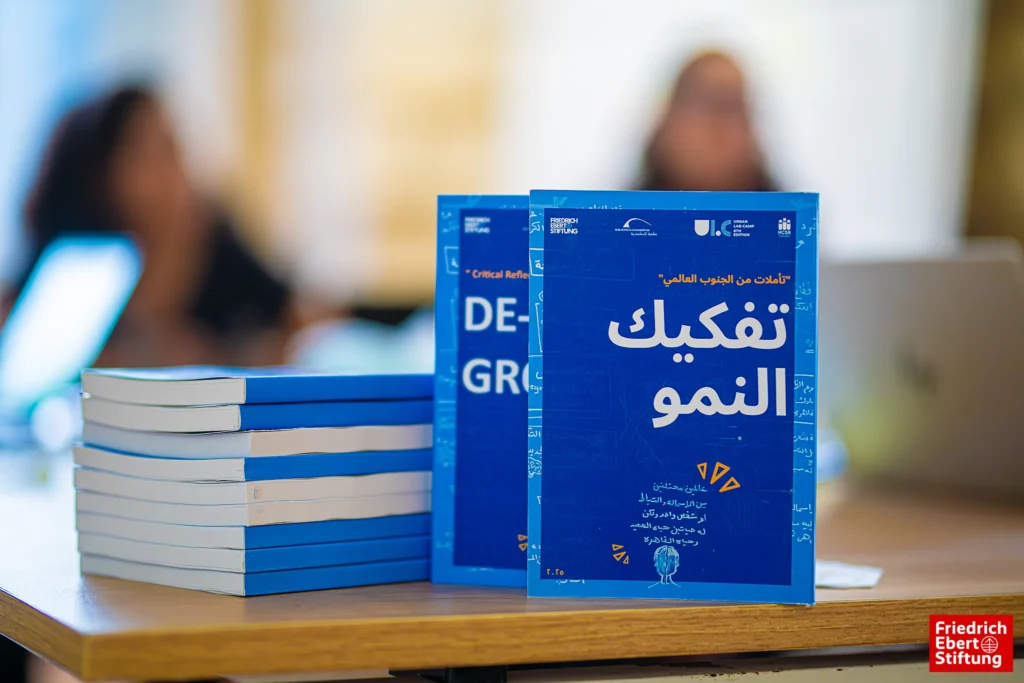
“It seems that the world is growing in reverse for us, the countries of the South.” An ascending straight line is often expected in economic growth, as such development projects and narratives are founded and created. Nations compete over natural resources to continue this upward trajectory towards prosperity. However, the flip side of this expectation to maintain the speed and boldness of the ascending straight line is that it moves like a carriage, breaking bodies in its path. Is it possible to slow down so that to think or reconsider the trajectory? Are nations really growing, or is it just a silly game that the world has been engaged in for thousands of years and has not lost its allure? This publication features the outcomes of the sixth Urban Lab Camp (ULC) held in Port Said from 12 to 16 September 2024, in partnership between Friedrich-Ebert-Stiftung (FES) Egypt Office, and the Bibliotheca Alexandrina, in collaboration with the Human and the City for Social Research (HCSR) and several specialists showcasing the Urban Lab Camp methodology as a cooperative platform of critical knowledge production on the intersections of urbanism, climate change and development. The volume focuses on the concept of “degrowth” from the perspective of the Global South, and specifically from the Egyptian experience, as an entry point to questioning the globally-dominant growth patterns and their relationship with urban transformations, climate changes and climate and social justice. Texts tackle the intersections of urbanism, consumerism, and managing natural resources, and pose questions on the beneficiaries and the marginalized from growth, and the possibilities of alternative paths towards a more just and sustainable development. Participants exceeded twenty, with varied educational and professional backgrounds across economics, urban planning, agriculture, arts, and humanities, and geographically ranging from the far north on the Mediterranean coast to the far south in Aswan, reflecting different approaches to the Egyptian experience and its positionality within the Global South. Such a publication aspires to be a tool for critical thinking, opening spaces to reconsider the concepts of progress and development, and relate them to the cities’ need and local potentials.
The Impact of Climate Change on Female Agricultural Workers
Risks Endangering Agriculture in the Nile Delta Amidst the global talks on Climate Change, and in light of Egypt hosting the Conference of Parties (COP27) in November 2022, there is an increasing interest in the consequences of Climate Change on Egypt. Agriculture is considered one of the most important economic sectors in Egypt in terms of production and job opportunities, and represents 15% of the gross domestic product (GDP)[1]. In this article, we focus on female agricultural workers, and the effect of Climate Change on them. The Nile Delta’s agricultural lands are expected to deteriorate owing to two main factors: firstly, the temperature rise, and accordingly, sea level rise. This increase threatens some agricultural lands in the Delta with sinking, especially agricultural lands on the Mediterranean coast such as Kafr El-Sheikh and Damietta. Secondly, the irrigation of the Delta agricultural lands by flooding as well as the rising temperature both lead to water evaporation, which increases the salinization of the soil in the long run. Thus, Climate Change threatens female agricultural workers, as they constitute 58% of total agricultural employment in 2020[2]. Moreover, the agriculture sector employs 45% of total women’s employment in Egypt[3]. As a result, any damage to the agriculture affects its female labor because it is fragile, given that they are seasonal, cheap, or unpaid. In addition, rural women face significant challenges in accessing financial resources, especially agricultural property. Female Agricultural Workers’ Status in Egypt In terms of work stability, women’s paid agricultural labor is majorly informal, since 99% of this labor is informal[4], i.e., they do not have formal labor contracts nor social or health insurance. In addition, a large segment of this employment is seasonal; whereby they work throughout specific times during the year, often within harvest periods, and are underpaid[5], seasonal employment represents 38% of the total agricultural female employment[6]. Climate change threatens the working conditions of agricultural workers, as rising temperatures and increased rainfall reduce women’s working hours, and/or lead to health risks, such as sunstrokes or severe fatigue caused by difficult weather. This compromises their economic conditions, given the nature of their seasonal and low-paid work. In Egypt, for example, female workers receive their salaries on a daily basis, and the average daily wage is estimated at only 6 USD.[7] Besides, a large segment of female labor is invisible because they perform unpaid work. In other words, women work within the family for her father, brother or husband, without monetary compensation. In the Egyptian rural areas, 79.5% of working women in the countryside work in a family project without pay, compared to 14.6% of working men in the countryside[8]. These activities range from direct agricultural work, such as plowing lands or harvesting the crops, in addition to activities related to agriculture, such as animal husbandry, sorting crops, and preparing dairy for sale[9]. Women Agricultural Property Despite the prominent participation of women in agricultural work in its various segments, women’s agricultural ownership is still modest. Women’s ownership represents 5.2% of the total agricultural land ownership in 2015[10], while women’s possession of land represents only 3%[11]. This inferior percentage can be attributed to social norms in the Egyptian countryside that give priority to ownership of men. Moreover, the social norms consider that women’s inheritance of land takes it out from the family, since its ownership -in their point of view- is transferred to women’s husbands. Accordingly, female agricultural labor spend long working hours and do not receive fair pay in return, or even their right to inherit agricultural land. Furthermore, agricultural property in general is fragmented; 81% of agricultural land does not exceed 3 acres[12]. Accordingly, women working in agriculture do not benefit equitably from their work, whether in terms of income or ownership[13]. Legal Background of Social Protection In light of former data, it is observed that 99% of women’s employment in agriculture is informal; which is the employment that does not have any labor contracts or social insurance from disability, old age and unemployment. Egyptian labor law excluded female agricultural workers from having women rights’ in workplaces; which are obligating the employer to provide nurseries for the children of female workers, and the right to paid maternity leave and childcare leave[14]. On the other hand, the Social Insurance and Pension Law encompasses seasonal agricultural workers, giving them the right to establish their own social insurance fund. Recommendations Based on these factors, female agricultural labor direly suffer from the consequences of climate change on agriculture in Egypt. Besides, they find that their jobs in agriculture, or the income of their entire family, are threatened. Those women do not have any economic alternative if they lose these opportunities, due to the lack of social protection, and limited access to resources. Therefore, female agricultural labor will face severe consequences of climate change in agriculture, which increases the necessity of providing them with social protection, and enhancing their access to resources through a fair payment for their work in agriculture. Footnotes: [1] “Climate Change Fact Sheets (in Arabic)”, The Human and the City for Social Research. Available at https://bit.ly/3eECVmR. Last visited: 18 October 2022. [2] ILO STAT Explorer, Egypt, Employment by Sex and Economic Activity. [3] Profile of Women in Rural Egypt, UN Women 2018. Available at: https://bit.ly/3VBYzc3 Last visited: 18 October 2022. [4] ILO STAT Explorer, Egypt, Informal Employment by Sex and Economic Activity. [5] Kandeel, Amal, Millions of Rural Working Women in Egypt at Risk from Climate Change. Middle East Institute – October 2017. Available at: https://bit.ly/3CL6eMN Last visited: 18 October 2022. [6] El Khorazaty, Noha. Egyptian Women’s Agriculture Contribution; Assessment of the Gender Gap for Sustainable Development. 2021. American University in Cairo, Master’s Thesis. AUC Knowledge Fountain. Available at: https://fount.aucegypt.edu/etds/1533 [7] Mona Ezzat, Al’Amelat ElZara’iat: Hokouq Daa’a ma bayn AlIsteghlal wal Tahmish, Friedrich-Ebert-Stiftung Egypt: 2021. Available at: https://bit.ly/3D9BPsE. Last visited: 18 October 2022. [8] Calculation from “Annual Report of Workforce Research 2020 (in Arabic)” pg. 55, Central Agency for Public [9] Profile of Women in Rural Egypt, UN Women 2018. Available at: