The Environmental Impact of the Israeli Wars
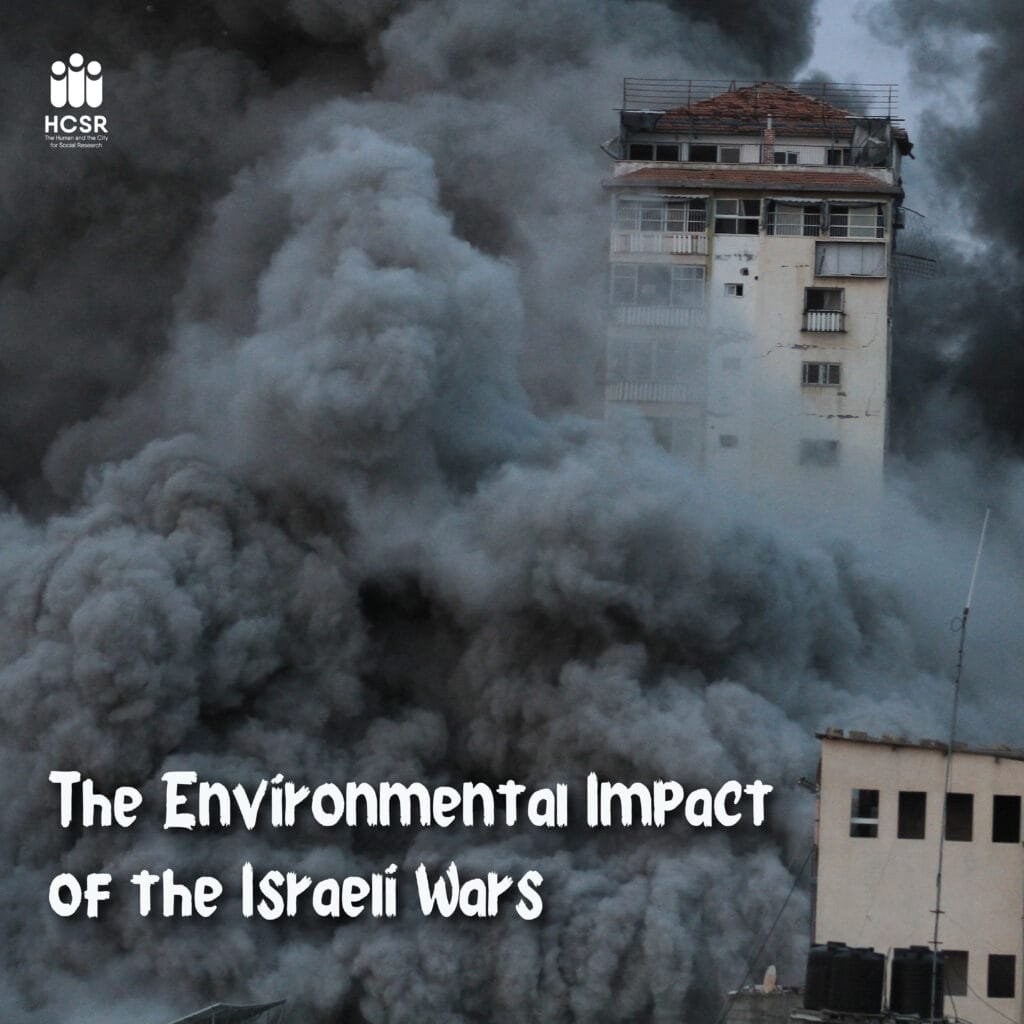
A whole year of environmental destruction in the region renders any environmental talks or campaigns mere nonsense. The significant and ongoing environmental damages of what the occupying entity has been doing in Gaza for the past 12 months, and what it is currently doing in Lebanon, could reach the entire planet and the region in particular, akin to what fossil fuels and plastic could do for years. These result in catastrophic effects on the region as a whole, as well as on the ecosystems of the Mediterranean, and vital infrastructure, directly threatening the health and lives of the people of Gaza and Lebanon. The Israeli army observes the “scorched earth policy” to destroy what it cannot occupy, including land, crops, natural resources, and infrastructure, notwithstanding the environmental impact that extends to the areas it controls, and expands to encompass the entire region. Land: 1- Military operations have led to soil contamination with heavy metals such as lead and mercury, along with toxic chemicals, causing soil infertility and chronic diseases including cancer. 2- Military operations in Gaza have destroyed over 42% of agricultural and arable lands in Gaza, with the United Nations estimating losses from these damages at nearly 629 million USD until June 2024. 3- Military operations have destroyed nearly 90% of olive tree agricultural lands in various areas of the Gaza Strip, depriving the people of Gaza of olive harvesting for the second consecutive year. Olive trees take at least five years to bear fruit. The destruction of olive trees affects the environmental balance, increases desertification, and negatively impacts biodiversity, not to mention the economic aspect and the population’s reliance on the crop. 4- The Israeli crimes have turned Gaza’s land into dangerously polluted land, affecting health and destroying the food security of the area, thus its dependence on food aid post-war for long decades, indicating that the war of starvation continues even after the war of arms. Additionally, all what is happening to Gaza’s land has a direct impact on the environmental balance of the region, including lands under the Israeli control. Water: 57% of water facilities, including desalination plants, wells, and water networks, have been destroyed, leading to a severe water shortage. Over 162 wells have been destroyed, in addition to the 3 main water desalination plants in Gaza, resulting in a loss of 95% of the water production capacity in Gaza Strip and estimated losses of 503 million USD. Groundwater contamination with heavy metals and chemicals resulting from military operations renders 97% of water in Gaza undrinkable for humans, animals, or irrigation. According to the World Health Organization, nitrate levels are 6 times higher than the permissible limit. Cases of waterborne diseases, such as diarrhea and hepatitis, have indeed increased due to water pollution. Pollution from sewage water and chemicals leads to groundwater contamination. The collapse of sewage treatment networks has led to the discharge of 60,000 cubic meters of untreated water daily into the Mediterranean Sea, causing pollution and destruction of marine habitats. Estimates indicate that 25% of the sea water near Gaza has become contaminated with harmful bacteria and heavy metals. Pollution can be carried through marine currents to neighboring countries in the Mediterranean Sea, such as Egypt, Lebanon, Turkey, and Greece, threatening water quality and fish resources in these countries. Moreover, Israel heavily relies on sea water desalination plants that it pollutes, endangering everyone’s lives. Air Pollution: 1- Continuous bombing, explosions, and airborne dust from the rubble have led to the release of thousands of tons of fine particles and chemicals into the air, including sulfur dioxide, nitrogen oxides, and toxic particles such as asbestos. 2- The number of fires due to the aggression from October 2023 to only January 2024 reached 165 fires, including 19 in industrial areas, resulting in air pollution with toxic chemicals. 3- This pollution poses a significant risk to the respiratory health of the population, especially with continued inhalation of fine particles. Hospitals have witnessed a 300% increase in respiratory diseases and asthma cases during the first three months of the aggression alone, affecting over 179,000 individuals, including children and the elderly. 4- The total rubble generated by military attacks has exceeded 39.2 million tons, equivalent to over 10 pyramids of Giza. This quantity also covers more than 365 square kilometers, the total area of Gaza, with a height exceeding one meter of rubble, which is 13 times more than the total rubble resulting from all previous wars since 2008. The rubble contains hazardous materials including over 800,000 tons of potential asbestos and unexploded ordnance (UXOs). Airborne dust poses a respiratory hazard, especially with the presence of toxic substances. These materials will continue to pose a health risk to the population for decades to come. 5- Approximately 1,100 to 1,200 tons of waste accumulate daily in the affected areas, including 400 tons daily in displacement sites alone. Over 1.5 tons of contaminated medical waste are left untreated every day in hospitals, increasing the risk of spreading infectious diseases and hazardous chemicals. With waste transportation issues unresolved, residents resort to burning waste outdoors, further complicating the issue of air pollution. 6- Air pollution spreads to neighboring countries with the wind, including territories under Israeli occupation in the West Bank, Egypt, Jordan, Lebanon, Syria, Turkey, and Greece. 7- Toxic gases emissions and fine particles resulting from destruction may contribute to rising temperatures, and exacerbate the effects of climate change in the Mediterranean region, contributing to global climate change. It is worth mentioning that the above information is the latest recorded data, not to mention the damages that are yet undocumented, or the updated damages caused by the failure of the international community to stop the year-long ongoing genocide. The environmental impact of the war on Gaza requires a rapid and comprehensive intervention to protect the population and the environment in the short and long term. The international community has to take urgent measures to provide support and assistance in rebuilding the environmental infrastructure and enhancing the protection of natural
Themselves the Verge of Seas to be:Scientists and Storytellers of the Rising Sea in Alexandria

Soha Mohsen[1] Introduction According to the United Nations’ best-case scenario, at least 30% of the city of Alexandria will be flooded and over a quarter of the population will have to be rehoused by the year 2050. As reported by the UN Climate Panel (IPCC) in their 6th assessment report, the rising sea level of the Mediterranean due to climate change will have dramatic implications because its deep waters will warm more than all the oceans. This suspended futurity of Egypt’s second biggest metropole and its most historically significant port city intimately intersects with the overall uncertainty and instability lived and experienced by Egyptian subjects in the complicated and prolonged aftermath of the 25 January 2011 revolution, whereby the discourse of “sinking” operates not only on the level of city’s materiality but also on the level of a collapsing national economy. The shore that is disappearing and being lost to the Alexandrian public- due to the rapid and aggressive privatization by the state- is the same shore that is witness to the rising sea levels due to global warming. Taking this paradox between the appearance/ disappearance of the sea-and-land scopes, this project seeks to understand how the rising sea becomes the site of contested epistemologies, imaginations and representations in Alexandria, in relation to Egyptian politics, cultural production and scientific discourse. Drawing on ethnographic fieldwork and archival research, this paper begins by introducing the context of my study, elaborating on Alexandria’s status of “endangerment” as demonstrated and discussed by local and national oceanographic and marine scientists. After that it moves on to share a brief reflection based on ethnographic interviews and archival research, exploring the history of the oceanographic sciences in Egypt (specifically along Egyptian Mediterranean), namely the establishment of the National Institute for Oceanography and Fisheries (NIOF) as well as the Department of Oceanography at the Faculty of Sciences in Alexandria University. I aim to understand the complex subjectivity that oceanographers and marine scientists embody in endangered coastal cities, and the ways in which their personal and professional encounters with the sea shape and become shaped by the larger political, economic and cultural atmospheres of Alexandria. Lastly, the paper ends with a discussion of the nature of knowledge making about the sea-level rise (or the absence thereof) that unfold in relation to, about, and in proximity to the sea. Note on methods used: The vignettes presented in this paper are based on fieldwork over 9 months from September 2023 to May 2024. During this period of ethnographic fieldwork, I deployed several ethnographic methods simultaneously, such as: archival research, semi-structured interviews, and participant observation. The data/ findings in this paper are based on in-depth, semi-structured interviews with members from the National Institute of Oceanography and Fisheries and the Department of Oceanography at the Faculty of Sciences, Alexandria University, combined with my experience as a Visiting Researcher at the Human and the City Center for Social Research (HCSR) in Alexandria during the period between November 2023 and May 2024. I am tremendously grateful to HCSR team for welcoming me into their space and for continuing to provide me with profound insights about the urban, sociocultural and maritime histories of Alexandria. Context: The IPCC AR6 report advises that climate change will exacerbate storm surges and coastal flooding in the eastern Mediterranean basin in the upcoming decades. The above is particularly critical for low-lying arid cities in developing nations like Alexandria. Alexandria projects a high-end rate of sea-level rise ranging between 6.4 and 7.8 mm per year (IPCC 2021). The sea level is expected to rise between 0.2 m and 0.25 m at Alexandria by 2050, threatening fisheries on the Mediterranean Sea coast in Egypt and its low-lying coastal tourist areas (World Bank Group, 2014, p. 129). As the report indicates; “Egypt, Libya, Morocco and Tunisia are the most exposed countries to sea-level rise (World Bank, 2014). Among MENA countries, Egypt is particularly exposed with several coastal cities at risk of inundation (Frihy et al. 2010; Solyman and Abdel Monem, 2020; Elshinnawy and Almaliki 2021).” I started my fieldwork journey in Alexandria in the windy fall season of 2023, with certain expectations about the anxious atmosphere of a city that is on the brink of “sinking”. “Being there” (Favret-Saada 1990; Giordano 2023) among different local communities of residents, scientists, researchers and cultural producers, introduced me to a different, even more nuanced reality. Living in Alexandria, working among and with local communities, I came to contact with a scene of loss that, surprisingly, is not on-the-way but already here, acutely present and powerful. Whether Alexandria is going to sink, partially or completely, or not at all, is an issue discussed and ‘assessed’ by numerous scholars and scientists, and investigated in multiple past and ongoing research projects. Consulting these reports, documents, announcements and studies while also living in the city, I came to realize that the notion of sinking quite poetically and with precision captures much of the present condition in Alexandria. Echoing Stefan Helmreich’s remarks on seawater as a theory machine, I suggest that seawater has become an explicit figure for anthropological and social theorizing, “especially in the age of globalization, which is so often described in terms of currents, flows, and circulation”. I also join Helmreich in his critical take on the generativity of watery metaphors to our modes of social and cultural analysis. Similar to him, I am interested in employing sea-water as a theoretical and an explanatory tool (theory machine) while at the same time as a phenomenon to be examined in and of itself (a thing in the world) (Helmreich 2011). “An estimated 45 percent of the population of Alexandria currently lives on land situated below sea level” (Michel 2010). In Alexandria, for a scenario involving a sea level rise of 0.5 meters over the next century, about 30% of the city would be lost to inundation and saltwater intrusion if no countermeasures were taken (ElRaey 2010). How is sea level rise encountered, known, and conceptualized in Alexandria? How does
Alexandria Green x Blue Workshop

The Human and the City for Social Research collaborated with Banlastik in organizing and facilitating “Alexandria Green x Blue” workshop. HCSR conducted several lectures on the concept of advocacy as a tool for changing environmentally harmful behaviors, the impact of climate change on the sea, rethinking the social consequences of encroachments on beaches, and important data on green spaces and their relationship with the Alexandrian community, emphasizing their significance in addressing climate change. The workshop was part of the Alfinmotion program, which lasted from 29 February to 2 March 2024. It was a knowledge and exploration workshop where participants and facilitators shared stories about nature and the sea. They learned about the biodiversity of marine microorganisms and rare plants in Alexandria, while emphasizing the need for societal behavior change and rediscovering neglected beaches and unsafe green spaces. The workshop targeted all those interested in environmental activities and human rights in the city and public spaces.
World Day of Social Justice| 2023
The 20th of February was marked as the World Social Justice Day by the General Assembly of the United Nations in 2007. This year’s theme is “Overcoming Barriers and Unleashing Social Justice Opportunities“, as the global trend of global development, which depends on achieving the sustainable development goals by reaching 2030, takes into account the great transformations that have occurred during previous years, which affected the performance of many countries at the level of economy and at the level of justice as well, which makes us more aware that social justice may be the way to remedy road difficulties and build more effective mechanisms. The absence of social justice directly affects the achievement of the basic goals of sustainable development; it reinforces poverty, makes it difficult to fight global hunger, and impedes the process of comprehensive development. According to the official website of the United Nations, the World Day of Social Justice provides an opportunity to enhance dialogue, especially with social partners and civil society organizations, which enhances everyone’s ability to strengthen the social contract that is struggling to survive, especially with the outbreak of conflicts, the rise of many currents, and major economic transformations at local levels, especially with the intense global anticipation of recession and depression expected to affect more than two-thirds of the world’s countries. In Egypt, for example, the Human Development Report, issued by the United Nations Development Programme (UNDP) in partnership with the Ministry of Planning, indicates a decline in the human development index according to wage equity during the previous decade 2010-2020, while monitoring macroeconomic resilience during the Corona crisis, which significantly affected most international economies. This report confirms what we seek to point out and work to solve, which is the gap between the macroeconomics of the state and the micromechanisms in society, as we believe that community participation– at all levels of disseminating information and awareness and contributing to planning, control and governance- may be the solution to the challenges ahead.