Urban Lab Camp 2024| Degrowth: Reflections from the Global
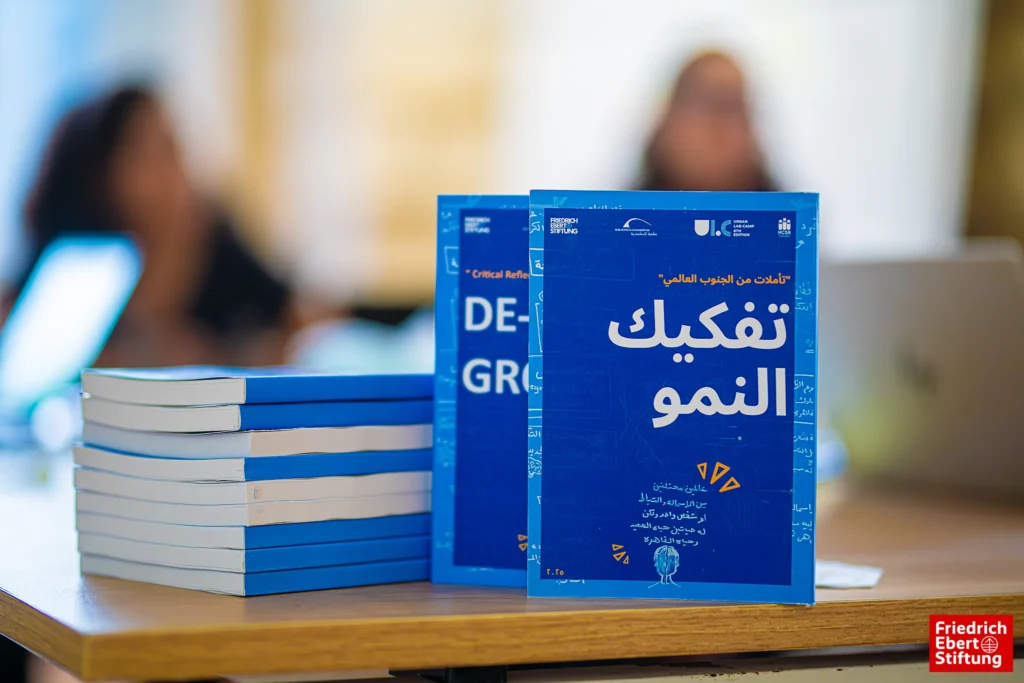
“It seems that the world is growing in reverse for us, the countries of the South.” An ascending straight line is often expected in economic growth, as such development projects and narratives are founded and created. Nations compete over natural resources to continue this upward trajectory towards prosperity. However, the flip side of this expectation to maintain the speed and boldness of the ascending straight line is that it moves like a carriage, breaking bodies in its path. Is it possible to slow down so that to think or reconsider the trajectory? Are nations really growing, or is it just a silly game that the world has been engaged in for thousands of years and has not lost its allure? This publication features the outcomes of the sixth Urban Lab Camp (ULC) held in Port Said from 12 to 16 September 2024, in partnership between Friedrich-Ebert-Stiftung (FES) Egypt Office, and the Bibliotheca Alexandrina, in collaboration with the Human and the City for Social Research (HCSR) and several specialists showcasing the Urban Lab Camp methodology as a cooperative platform of critical knowledge production on the intersections of urbanism, climate change and development. The volume focuses on the concept of “degrowth” from the perspective of the Global South, and specifically from the Egyptian experience, as an entry point to questioning the globally-dominant growth patterns and their relationship with urban transformations, climate changes and climate and social justice. Texts tackle the intersections of urbanism, consumerism, and managing natural resources, and pose questions on the beneficiaries and the marginalized from growth, and the possibilities of alternative paths towards a more just and sustainable development. Participants exceeded twenty, with varied educational and professional backgrounds across economics, urban planning, agriculture, arts, and humanities, and geographically ranging from the far north on the Mediterranean coast to the far south in Aswan, reflecting different approaches to the Egyptian experience and its positionality within the Global South. Such a publication aspires to be a tool for critical thinking, opening spaces to reconsider the concepts of progress and development, and relate them to the cities’ need and local potentials.